Research

For the start of my research I looked into what is foley about and why is it need. As I explained in my proposal I am creating foley, therefore understanding the core structure of the media technique seemed important.

What is "Foley"?
Foley effects are sound effects added to the film during post-production (after the shooting stops). They include sounds such as footsteps, clothes rustling, crockery clinking, paper folding, doors opening and slamming, punches hitting, glass breaking, etc. etc. In other words, many of the sounds that the sound recordists on set did their best to avoid recording during the shoot.
For my project i am recreating a scene from pirates and the Caribbean
The video link is here : https://www.youtube.com/watch?v=UwXO9P79o2c&list=WL&index=2&t=0s
NOTE : I am recreating sounds from 0:50 to 2:17 in the video above.
JOBS IN FOLEY :
For my project i am recreating a scene from pirates and the Caribbean
The video link is here : https://www.youtube.com/watch?v=UwXO9P79o2c&list=WL&index=2&t=0s
NOTE : I am recreating sounds from 0:50 to 2:17 in the video above.
JOBS IN FOLEY :
The boom operator's job is to clearly record the dialogue and only the dialogue. At first glance, it may seem odd that we add back to the soundtrack the very sounds the sound recordists tried to exclude. In pirates and the Caribbean they use soundtracks a lot , I will do the same however you will clearly be able to hear the sound effects. But the keyword here is control. By excluding these sounds during filming and adding them in the post, we have complete control over the timing, quality, and relative volume of the sound effects. Balancing sound effects and soundtrack is important.
For example, an introducing y shot of a biker wearing a leather jacket might be enhanced if we hear his jacket creak as he enters the shot but do we really want to hear it every time he moves? By adding the foley sound fx in the post, we can control its intensity, and fade it down once the dialogue begins. Even something as simple as boots on gravel can interfere with our comprehension of the dialogue if it is recorded too loudly. Far better for the actor to wear sneakers or socks assuming their feet are off-screen and for the boot-crunching to be added during Foley.
Why do we Bother with Foley?
Without Foley, a film sounds empty and hollow - the actors seem to be talking in a vacuum. The sound recordist, if they did a good job, has given us the dialogue and excluded everything else, but our films need more than this for the picture to come alive. We need to hear the little sounds of clothes, furniture, etc - but we need to control those sound effects so they don't obscure any of the dialogue.
Another common use for Foley sound replacement is adding it to documentary footage. The old historical film seems lifeless when it is screened without sound, and adding foley to it helps bring those long dead images to life. Next time you watch a history documentary that uses silent archival footage, listen closely and you should hear at least minimal Foley sound fx, mostly footsteps, behind the narration.
Foley can also be used to enhance comedy or action scenes. Watch most comedy films and you'll notice that many of the sounds are enhanced for comic effect, and sometimes the Foley sound is the joke. As for action, most fistfights do not involve the actors really hitting each other, and even if they did we would not be able to record a satisfying punch sound. By punching and variously molesting such objects as cabbages, celery and sides of beef, Foley artists can record bizare and much more 'realistic' action sounds.
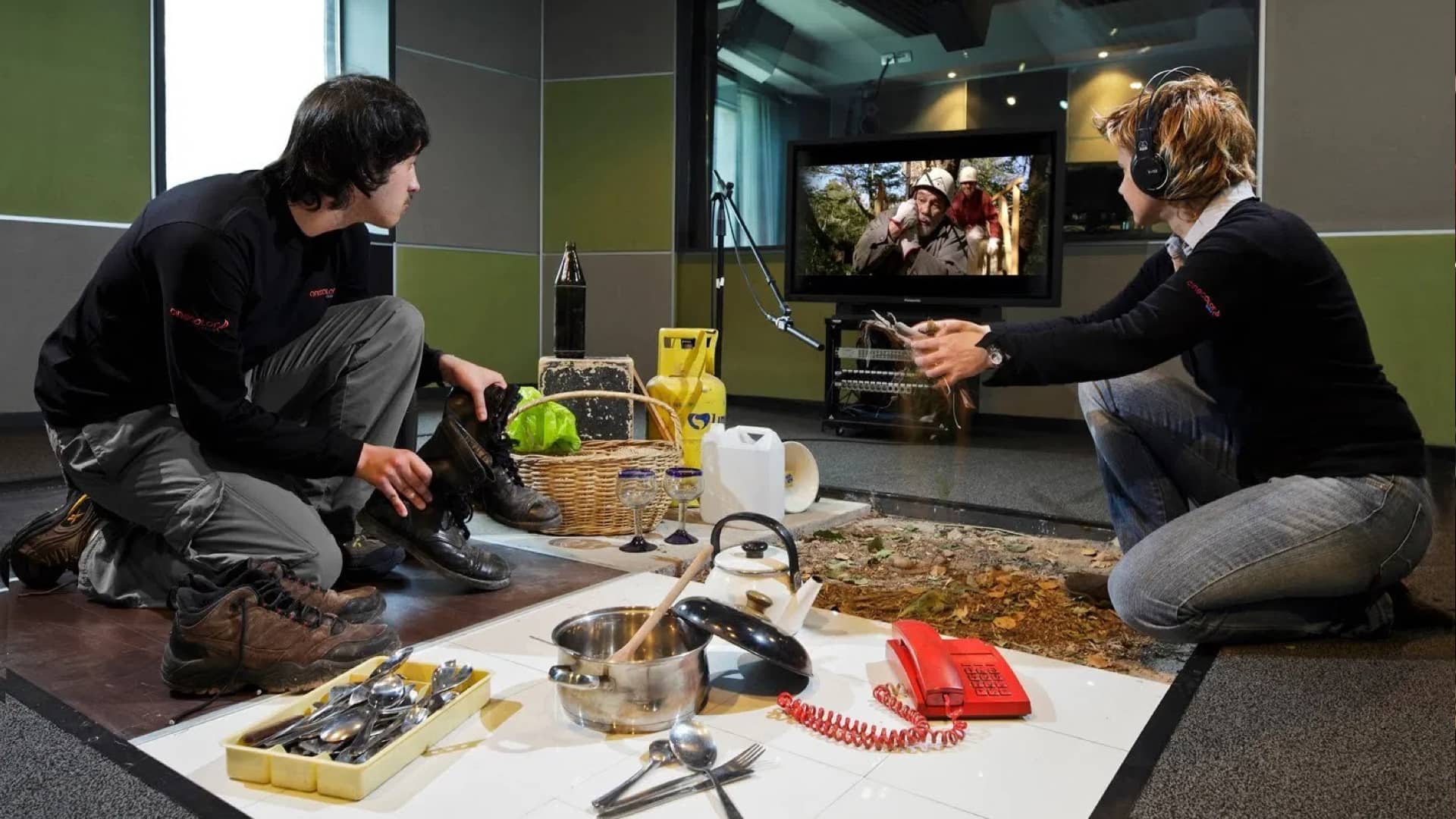
How people use foley and how i will use the techniques in my sound project :
Footsteps
As mentioned in the Foley artist definition, reproducing the sound of footsteps is done by wearing different kinds of shoes and walking on different kinds of surfaces to get the perfect sound for the character. In the scene in the clip i am using there is sound of sand , wood and brick , i have used all floor materials that the video uses.
Movement
The amount of detail and meticulousness required is excessive. Even the smallest movement, like a person crossing their legs with jeans on, needs to make a sound.
Props
Foley artist Marko Costanzo used leaves to create the swirling sound of the witch from Into the Woods. He also used the cracking of celery to create the sound of breaking bones in The Big Lebowski. lots of films use celery to create a breaking bone sound.
DIEGETIC VS. NON-DIEGETIC SOUND
Diegetic sound is any sound that the character or characters on screen can hear. So for example the sound of one character talking to another would be diegetic. Non-diegetic sound is any sound that the audience can hear but the characters on screen cannot. Any appearance of background music is a prime example of non-diegetic sound. This clip from Shaun of the Dead uses both diegetic and non-diegetic sound. The sounds of the characters speaking, the records flying, and the zombies are all diegetic , the characters can hear them. Meanwhile, the beats and riffs of the background music serves as an example of non-diegetic sound that goes unheard by Shaun, Pete, and the menacing zombies.
DIRECT SOUND
Direct sound is all of the sound that is recorded at the time of filming. In this scene from Talladega Nights: The Ballad of Ricky Bobby, the only sounds are those that occurred when the scene was filmed. The main sound in the scene is the characters’ dialogue, but some subtle direct background noises, such as popping gum, can be heard as well. No post synchronous sounds or music occur in the scene, which places emphasis on the characters’ dialogue and creates a more realistic, believable ambience.
Particular sounds both musical and non-musical
which are used to enhance key moments.
Spot effects - adding the sound of the car door
slamming (may not have come out well on screen) so
added afterwards. Has to be at particular hit
points. Opening and closing the metal ironing board
mimics the sound of opening a farm gate - if not
recorded well on location (has a link to foley).
Special effects - simulates fire, earthquake, lighting. So in my case making sword noises i will use knives to create the sound.
Materials
The first step in creating footstep sound effects is putting together a decent foley pit. Professional foley artists build large frames which can either be portable or dug into the ground, but if you're just starting out, a kiddie pool will do just fine. Once you have your pit, you'll need to select the materials you'll need to create the specific textures your project calls for.
https://youtu.be/eobm9HzVnvI
In the video, Janney uses potting soil for dirt, gravel for, well, gravel, and cornstarch packed into a pillowcase for snow, but there are many other types of techniques and materials you can use to create different foley footsteps. For example, foley artist Susan Fitz-Simon places audio tape over astroturf to create the sound of walking in grass.
Surfaces
Be aware that the surfaces you use, both the one you're stepping on and the one on the bottom of your shoes, will change the way your footsteps sound. Wood has a deeper tone than tile. Wingtips will create higher pitched sounds than a pair of rubber boots. So, pay attention to not only the surfaces your subject is walking on but also the shoes they're wearing while they do it. You don't have to match the surface and footwear exactly—foley artists are famous for using creativity to make sounds out of unusual and unexpected things (like breaking celery to mimic the sound of broken bones)—but it's at least a good place to start.
Walking style
The way you walk matters greatly when creating foley footsteps. What is the walking style of your subject? Do they take hard steps? Do they have a limp? Do they drag their feet a little? All these little idiosyncrasies should be reflected in your foley. Another great tip mentioned by Fitz-Simon is to try and capture both the heel and toe sounds when walking, which means you might look a little funny as you're doing it. This is important to remember because when walking in place in a foley pit, you're not really coming down on your heels,
CONTRAPUNTAL SOUND
Usually the sound we hear in a film directly accompanies what we see on the screen; it is appropriate sound, it is the sound we expect. The music in Trainspotting matches what we see in the film and seems relevant to the characters, their lifestyles, and the pace of the film. In other words, the music works in parallel with the visual content of the film. However, this is not always the case. In both A Clockwork Orange (1971) and GoodFellas, horrific acts of violence are accompanied by bright, happy, energetic music rather than the sinister, threatening incidental music we may expect. This is an example of contrapuntal sound. The sound works against what we see on the screen. In these particular cases the effect is to emphasise the characterss casual, sometimes gleeful attitude to violence while also shocking the viewer.
EXAMPLES
RAIDERS OF THE LOST ARK
SOUND : ROLLING BOULDER
WHAT THEY USED TO MAKE THE SOUND : ROLLING CAR WITHOUT A MOTOR RUNNING
https://audioboom.com/boos/2975600-02-raiders-of-the-lost-ark-rolling-boulder
Sound effects man ''Richard Anderson'' explained that the boulder that Indiana Jones runs away from at the start of Raider of the lost ark. "It was rolling a car without a motor, and also one of those big, heavy lawn rollers to make your lawn flat: rolling that down a hill.” Some of the truck sounds in the chase sequences, meanwhile, were made with tiger growls.

Star Wars
Effect needed: Blaster pistol
Actual sound: Steel cable
https://audioboom.com/boos/2975604-03-star-wars-blaster-pistol
Ben Burtt achieved that sound of the Star Wars series blaster guns by beating a cable with a hammer. he even found the specific sound he wanted by climbing a radio mast and hitting its guide cables.

Terminator 2: Judgment Day
Effect needed: Crushed skull
Actual sound: Pistachios
in the opening after-the-war shots of T2 they show the metal exoskeleton-type Terminators moving across a bombed out landscape. The sound of the wind was simply recorded by sticking a mic at the crack of a door leading outside at George Lucas Sky walker Ranch, with an element of a human voice making "whoosh" noises. The sound that binds the shot of the Terminator stamping on a human skull is a pistachio nut being ground into a metal plate.

Pirates of the Caribbean has a wide range of attractive qualities such as the fast paced action and the way the camera work, music and action fit in together to make a fantastic family film witch draws you to watch it again and again. so this means that my target audience will be in between 13-15 , the reason why i chose this age is because its the age rating for the film. Disney's target market varies from children, to tweens, to teenagers and even adults - practically anyone who is young at heart. As Walt Disney himself once quoted "Your dead if you aim only for kids.
Reviewing what age i think the film should be :
Children under 12 :
Due to the degree of horror, the supernatural themes and the level of violence in this film, it is not suitable for children under the age of twelve years.
Children aged 12 to 13:
this movie is likely to be appealing to children, particularly boys, in this age group. Some of them may be able to handle the horror and supernatural themes; however, many children aged 12 to 13 could still be very disturbed by the movie.
Children over the age of 13 :
Most children over the age of 13 will be able to see this movie, although some children in this age group may still need parental guidance.
Violence was featured throughout then entire film from beginning to end. At times the use of violence was presented in a realistic manner, such as:
ship’s cannons battering navy forts
people being impaled on swords
people having their throats cut.
The use of violence was made too look goodd by attractive looking heroes s who were able to employ the use of violence in an extremely effective and stylish manner. The use of violence by the villains while effective was presented in a less attractive and far more brutal manner.
Violence was presented as a socially acceptable means to an ends, and portrayed little real life consequences such as pain and suffering. Heroes were able to quickly bounce back from blows that would be fatal to most, while the evil heroes were completely impervious to harm.
The first step in creating footstep sound effects is putting together a decent foley pit. Professional foley artists build large frames which can either be portable or dug into the ground, but if you're just starting out, a kiddie pool will do just fine. Once you have your pit, you'll need to select the materials you'll need to create the specific textures your project calls for.
https://youtu.be/eobm9HzVnvI
In the video, Janney uses potting soil for dirt, gravel for, well, gravel, and cornstarch packed into a pillowcase for snow, but there are many other types of techniques and materials you can use to create different foley footsteps. For example, foley artist Susan Fitz-Simon places audio tape over astroturf to create the sound of walking in grass.
Surfaces
Be aware that the surfaces you use, both the one you're stepping on and the one on the bottom of your shoes, will change the way your footsteps sound. Wood has a deeper tone than tile. Wingtips will create higher pitched sounds than a pair of rubber boots. So, pay attention to not only the surfaces your subject is walking on but also the shoes they're wearing while they do it. You don't have to match the surface and footwear exactly—foley artists are famous for using creativity to make sounds out of unusual and unexpected things (like breaking celery to mimic the sound of broken bones)—but it's at least a good place to start.
Walking style
The way you walk matters greatly when creating foley footsteps. What is the walking style of your subject? Do they take hard steps? Do they have a limp? Do they drag their feet a little? All these little idiosyncrasies should be reflected in your foley. Another great tip mentioned by Fitz-Simon is to try and capture both the heel and toe sounds when walking, which means you might look a little funny as you're doing it. This is important to remember because when walking in place in a foley pit, you're not really coming down on your heels,
CONTRAPUNTAL SOUND
Usually the sound we hear in a film directly accompanies what we see on the screen; it is appropriate sound, it is the sound we expect. The music in Trainspotting matches what we see in the film and seems relevant to the characters, their lifestyles, and the pace of the film. In other words, the music works in parallel with the visual content of the film. However, this is not always the case. In both A Clockwork Orange (1971) and GoodFellas, horrific acts of violence are accompanied by bright, happy, energetic music rather than the sinister, threatening incidental music we may expect. This is an example of contrapuntal sound. The sound works against what we see on the screen. In these particular cases the effect is to emphasise the characterss casual, sometimes gleeful attitude to violence while also shocking the viewer.
EXAMPLES
RAIDERS OF THE LOST ARK
SOUND : ROLLING BOULDER
WHAT THEY USED TO MAKE THE SOUND : ROLLING CAR WITHOUT A MOTOR RUNNING
https://audioboom.com/boos/2975600-02-raiders-of-the-lost-ark-rolling-boulder
Sound effects man ''Richard Anderson'' explained that the boulder that Indiana Jones runs away from at the start of Raider of the lost ark. "It was rolling a car without a motor, and also one of those big, heavy lawn rollers to make your lawn flat: rolling that down a hill.” Some of the truck sounds in the chase sequences, meanwhile, were made with tiger growls.
Star Wars
Effect needed: Blaster pistol
Actual sound: Steel cable
https://audioboom.com/boos/2975604-03-star-wars-blaster-pistol
Ben Burtt achieved that sound of the Star Wars series blaster guns by beating a cable with a hammer. he even found the specific sound he wanted by climbing a radio mast and hitting its guide cables.
Terminator 2: Judgment Day
Effect needed: Crushed skull
Actual sound: Pistachios
in the opening after-the-war shots of T2 they show the metal exoskeleton-type Terminators moving across a bombed out landscape. The sound of the wind was simply recorded by sticking a mic at the crack of a door leading outside at George Lucas Sky walker Ranch, with an element of a human voice making "whoosh" noises. The sound that binds the shot of the Terminator stamping on a human skull is a pistachio nut being ground into a metal plate.
WHY IS FOLEY IMPORTANT :
Foley is a vital part of a film. It's not as difficult to do as many people think and when i try it i hope i can get some great effects easily. Without Foley, you can have scenes that feel empty because the main noises are missing. Our human senses know that certain actions make sound and are key to hear them. Without this vital tool in the filmmaking industryui, our scenes would seem flat and empty.
It really makes the difference between a film sounding great or just sounding wrong. The fact this has been used for most of film history should tell you how important it is in the film making process. I need to make sure when i am recording, I should place the mic a few feet away from the sound source. This helps reduce noise that humans make when they're actually making the sound.
Foley is a vital part of a film. It's not as difficult to do as many people think and when i try it i hope i can get some great effects easily. Without Foley, you can have scenes that feel empty because the main noises are missing. Our human senses know that certain actions make sound and are key to hear them. Without this vital tool in the filmmaking industryui, our scenes would seem flat and empty.
It really makes the difference between a film sounding great or just sounding wrong. The fact this has been used for most of film history should tell you how important it is in the film making process. I need to make sure when i am recording, I should place the mic a few feet away from the sound source. This helps reduce noise that humans make when they're actually making the sound.
TARGET AUDIENCE:
Pirates of the Caribbean has a wide range of attractive qualities such as the fast paced action and the way the camera work, music and action fit in together to make a fantastic family film witch draws you to watch it again and again. so this means that my target audience will be in between 13-15 , the reason why i chose this age is because its the age rating for the film. Disney's target market varies from children, to tweens, to teenagers and even adults - practically anyone who is young at heart. As Walt Disney himself once quoted "Your dead if you aim only for kids.
Reviewing what age i think the film should be :
Children under 12 :
Due to the degree of horror, the supernatural themes and the level of violence in this film, it is not suitable for children under the age of twelve years.
Children aged 12 to 13:
this movie is likely to be appealing to children, particularly boys, in this age group. Some of them may be able to handle the horror and supernatural themes; however, many children aged 12 to 13 could still be very disturbed by the movie.
Children over the age of 13 :
Most children over the age of 13 will be able to see this movie, although some children in this age group may still need parental guidance.
Violence was featured throughout then entire film from beginning to end. At times the use of violence was presented in a realistic manner, such as:
ship’s cannons battering navy forts
people being impaled on swords
people having their throats cut.
The use of violence was made too look goodd by attractive looking heroes s who were able to employ the use of violence in an extremely effective and stylish manner. The use of violence by the villains while effective was presented in a less attractive and far more brutal manner.
Violence was presented as a socially acceptable means to an ends, and portrayed little real life consequences such as pain and suffering. Heroes were able to quickly bounce back from blows that would be fatal to most, while the evil heroes were completely impervious to harm.
Comments
Post a Comment